AmiNetXDuo 1.0.0-rc7
An IPv4+IPv6 TCP/IP stack for classic AmigaOS, and the networking commands to go with it. Provides bsdsocket.library on top of Eclipse ThreadX NetX Duo, driving the SANA-II cards you already have.
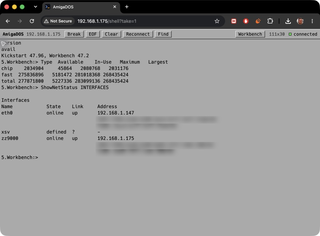
AmiNetXDuo 1.0.0-rc7 (NetX Duo 6.5.2, ThreadX 6.5.2)

**Download:** [AmiNetXDuo-1.0.0-rc7.lha](https://github.com/tinic/AmiNetXDuo/releases/download/v1.0.0-rc7/AmiNetXDuo-1.0.0-rc7.lha) -- unpack it, run `Install-AmiNetXDuo`.

**Also needed:**

- [Emu68](https://github.com/michalsc/Emu68/releases) -- PiStorm32; 1.1 alpha.1 or newer
- [ZZ9000 driver package](https://github.com/BlitterStudio/zz9000-drivers/releases) -- `ZZ9000Net.device`
- [plipbox multicast firmware and driver](https://github.com/tinic/plipbox/releases/tag/v0.6.2-multicast) -- plipbox adapters; use the matched firmware and `plipbox.device`

[README](https://github.com/tinic/AmiNetXDuo/blob/v1.0.0-rc7/README.md) · [What is missing](https://github.com/tinic/AmiNetXDuo/blob/v1.0.0-rc7/docs/GAPS.md) · [CHANGELOG](https://github.com/tinic/AmiNetXDuo/blob/v1.0.0-rc7/CHANGELOG.md) · [Issues](https://github.com/tinic/AmiNetXDuo/issues)

<details>
<summary>405 changes, from CHANGELOG.md</summary>


- NetPrefs Check now shows the update it found instead of saying that
  UpdateAmiNetXDuo could not be run. Starting and stopping an interface from
  NetPrefs no longer leaves files open.

## 1.0.0-rc6

- The Installer no longer computes checksums on the Amiga. On a 68000 an
  installation takes about as long as with rc4 again.

## 1.0.0-rc5

- AmiNetXDuo updates itself. Once a day at boot, UpdateAmiNetXDuo looks for
  a newer version and offers it with Install, Skip this version and Later.
  It installs the same kind of stack to the same places, and replaces only
  the files the Installer put there that nobody changed since.
- Every update is signed and every file is checked before anything changes.
  A power cut during an update is safe, and an update after which the
  network does not come up is taken back on the third boot.
- The Installer asks whether to check for updates at boot, and the new
  NetPrefs Updates page switches the check and chooses releases or
  pre-releases. A machine installed before this version needs the Installer
  run once before it can update.
- SyncReboot writes every volume's buffers to disk before it restarts the
  machine, so it is safe to use right after files are written.

## 1.0.0-rc4

- A PPP or SLIP interface without GATEWAY gets its default route through the
  other end, and a PPP interface without ADDRESS takes over the default route
  once the link agrees an address, as Roadshow's ppp_dialer does.
- A new address agreed while a PPP link stays online is picked up.
- AddNetInterface waits for a PPP link's address within TIMEOUT on every path
  and returns 5 if none arrives; CheckNetConfig no longer warns about a PPP
  or PLIP file without ADDRESS.
- ppp.device works: a numeric IPTYPE sets the packet type IPv4 travels as
  (ppp.device needs IPTYPE=33), and a point-to-point interface without
  ADDRESS takes the address the link agrees once it is up.
- The AmiTCP keyword INTERFACE in an interface file is accepted without a
  warning, and CheckNetConfig accepts a /32 SLIP file whose GATEWAY is the
  other end.
- CreateAmiNetXDuoStatusReport also lists the running tasks and the open
  connections, so one report shows what a stalled program waits on.
- CreateAmiNetXDuoStatusReport shows, for each waiting program, the calls it
  is waiting in, the programs using the network, and who holds the stack.
- Programs no longer hang opening bsdsocket.library when TCP: cannot be
  published.
- NetEnv also publishes each interface's hardware address, SANA-II driver,
  unit and driver version.
- A PCMCIA card's reset wait no longer ends early when the claim is
  interrupted while the delay clock is measured.
- A SLIP or PPP interface whose file names the other end as GATEWAY, with no
  DESTINATION, gets its default route through it, as AmiTCP and Roadshow files
  expect.
- AddNetInterface no longer races WirelessManager for the card when both
  start at boot, so the Wi-Fi network comes up every time.
- Offline takes a prism2.device card offline and stops its
  interrupts, as programs started by WHDLoad need.
- Offline also takes the card offline when its interface is set DOWN,
  so the card stops interrupting.
- Programs at normal priority, such as audio players, keep running
  without dropouts during a sustained download.
- AddNetInterface waits for a Wi-Fi card such as prism2.device to join
  its network before it attaches the interface, so the network starts at
  boot without WaitForLink; the wait shares the command's TIMEOUT.
- An interface whose card answers "out of service" when it is first
  opened comes back by itself once the card goes online, instead of
  staying down until the next boot.
- sntp takes the time zone from ENV:TZONE when it is set, including
  daylight saving, so the clock is no longer an hour out in summer;
  without it, Locale is used as before.
- WaitSelect() no longer reports a TCP socket readable while only data that
  arrived out of order is queued, so a blocking recv() after it no longer
  waits forever when the sender is gone.
- NetPrefs edits point-to-point interfaces: a Point-to-point checkbox and
  Peer fields for DESTINATION and DESTINATION6.
- AddNetRoute DESTINATION=<prefix> GATEWAY=<peer> routes an IPv6 prefix
  through a point-to-point link, for split VPN routes; DeleteNetRoute
  DESTINATION=<prefix> removes it.
- Point-to-point interfaces carry IPv6: ADDRESS6 and DESTINATION6 in the
  interface file, ConfigureNetInterface DESTINATION6=, and AddNetRoute
  DEFAULTGATEWAY <peer> for an IPv6 default route through the link.
- IPv6 programs built with the AmigaPorts GCC headers, where AF_INET6 is 23
  and struct sockaddr_in6 has no length byte, work.
- Up to four IPv6 default routes are kept, one per interface, so a VPN
  default fits beside routes learned on Ethernet and Wi-Fi.
- DeleteNetRoute DST=:: removes only a default route that was added by
  hand, never one learned from a router.
- Point-to-point interfaces: POINTTOPOINT and DESTINATION in an interface
  file, for drivers such as the OpenVPN client's vpn.device (IPv4).
- An address with a 255.255.255.254 or 255.255.255.255 netmask is no
  longer treated as a broadcast address, so TCP and ping to it work.
- DeleteNetRoute DST=0.0.0.0 removes the default route, as on AmiTCP.
- A network driver that refuses one kind of read, such as ARP or IPv6 on a
  point-to-point device, no longer keeps the stack's receive task busy
  asking for it again.
- Uploads through an NE2000-compatible card, a 3Com 3C589 or an A2065 copy
  each frame in longwords on the card's word boundary, which speeds up
  uploads on a 68020 to 68060; an A3000 with an X-Surf 100 sends 3% faster.
- TCP uploads build each segment's headers with word and longword stores.
- Receiving TCP reads the header fields it merges and the IPv6 checksum
  fields in words and longwords instead of one byte at a time.
## 1.0.0-rc3

- A WaitSelect() with a timeout times out again when its timer fires just
  as the call starts; it waited for the next packet or Ctrl-C before, and a
  queued name lookup could wait until Ctrl-C.
- NetShutdown no longer hangs when the last program closes
  bsdsocket.library while an ARexx KILL is being handled.
- A network driver that asks for a pause after it opens gets it; the stack
  skipped the pause before.
- A network driver that waits while an interface goes online or offline no
  longer stops NetMeter, ShowNetStatus, NetShutdown or programs opening
  bsdsocket.library until it returns.
- A DHCP offer or acknowledgement with unknown options no longer makes the
  DHCP client read past the received message.
- tls.library checks the length of every field in a server's ServerHello
  before reading it.
- A program waiting in recv() or accept() no longer holds up every other
  program once fifteen are waiting, so IBrowse can stop its connections and
  NetShutdown finishes.
- A program waiting for a free place in the stack stops on Ctrl-C.
- A network task that another program removes while it waits in the stack
  is no longer signalled afterwards, which could corrupt memory after
  IBrowse ignored its unfinished subtasks.
- A program removed while it waits in recv() no longer has a later packet
  written into its freed memory.
- WaitSelect() interrupted by Ctrl-C while the stack is busy returns EINTR
  instead of ENETDOWN.
- A program waiting in connect(), send(), a receive with a timeout or a DNS
  lookup no longer holds up other programs, and stops on Ctrl-C.
- A program removed while it waits in WaitSelect() with a timeout is no
  longer signalled by its timer afterwards.
- Replies from a host whose address ends in .0 or .255 on another network
  are accepted, so DA-Player gets CD titles from gnudb.gnudb.org.
- After a switch from the drawer installation to the system one, the tools no
  longer read interface files from the old drawer.
- A TCP connection whose IPv6 address expires or is withdrawn by the router
  no longer stops the network when a tail loss probe fires.
- A resent block that spans the 32-bit sequence number wrap is sent in full
  instead of waiting for another retransmission timeout.
- A blocking connect() returns as soon as the handshake completes instead of
  330 to 380 ms later.
- A listening socket holds new connections in the SYN cache once its backlog
  is full instead of refusing them, so a busy httpd no longer drops connects.
- WiFiPi no longer writes through a NULL pointer on a chip without an SDIO
  core, and BeginInterfaceConfig no longer crashes when no stack is running.
- Optional NetEnv commodity publishes current IPv4 and IPv6 addresses and
  default routes in ENV: for desktop tools such as NewMeter. It writes only
  changed configuration, removes stale values, and exports no traffic counters.

- A slow network driver such as plipbox is given only as many queued writes
  as it completes in about 20 ms, which cuts lost pings and latency during
  transfers; plipbox uploads no longer resend about one segment in ten.
- plipbox keeps a TCP receive window that fits its receive memory on paths
  with a round trip up to 95 ms.
- TCP holds new data while a network driver's write queue is half full
  instead of overflowing it, which ends multi-minute upload stalls over
  Pi Wi-Fi and other links slower than the CPU.
- After a retransmission timeout, a resent segment that is lost again is
  resent at once instead of after another timeout.
- TCP uploads hand the network driver blocks of up to 16 segments, which
  cuts the CPU cost per packet (all profiles except micro).
- Socket calls check for Ctrl-C by reading the task's received signals
  instead of calling SetSignal(0,0), which removes a Disable() per call.
- Sending on a socket makes no Exec call when the caller's event signal is
  already pending.
- anxgenet.device takes a block of up to 16 segments in one write (all
  profiles except micro).
- The TCP send buffer grows by itself on gigabit links with a long round
  trip; an explicit SO_SNDBUF keeps a fixed size.
- The TCP receive window grows by itself on fast links with a long round
  trip; an explicit SO_RCVBUF or TCPWANWINDOW keeps a fixed size.
- New TCP connections on a gigabit interface with a large packet pool
  start with a 10-segment window (RFC 6928).
- A TCP retransmission that is lost again is resent once later data is
  acknowledged, without waiting for the retransmission timeout.
- SACK loss recovery sends no more than the link carries, and a TCP upload
  over a lossy path completes.
- Frames leave in order when the driver's send queue is busy.
- NetShutdown removes bsdsocket.library and usergroup.library from memory
  once no program has them open.
- usergroup.library flushes the CPU caches after copying its jump table; an
  ixemul program no longer crashes with 80000004 on a 68040 or 68060.
- httpd listens on IPv4 when the IPv6 listener is refused.
- httpd -C starts without a readable front screen and checks the screen
  again when the console page opens.
- Installer writes WirelessManager lines live when only a commented-out
  line or NetWireless mentions WirelessManager.
- Installer leaves NetSwitch, NetMeter, NetPrefs, NetWirelessPrefs and
  NetWireless without a fixed icon position.
- NetSwitch has a Synchronize time checkbox that sets the clock by SNTP
  when an interface goes online.
- NetSwitch shows why a time synchronisation failed.
- sntp and httpd use the time zone that Locale shows when Locale prefs were
  never saved.
- TCP uploads keep up to 1024 segments in flight on a large packet pool, which
  doubles upload speed over long round trips.
- `TCPWANWINDOW` takes effect on gigabit interfaces too.
- TCP uploads no longer drop a burst of segments when the stack hears an
  ARP request from another host.
- WiFiPi no longer overwrites low memory when a multicast join runs out of
  memory, and handles multicast ranges wider than one request.
- Updated NetX Duo with upstream protocol and TLS fixes.
- TCP connections survive temporary loss of their local IPv6 address and
  can resume when that address is restored.

## 1.0.0-rc2

- The installer needs 2 MB of memory; the stacks still run in 1 MB.
- The trust store is Mozilla's root set of 20 October 2026, which drops the
  eMudhra emSign roots after their CA keys were found to be computable.
- IPv6 socket addresses use the BSD length/family prefix, as IPv4 does, and
  `sockaddr_storage` has `ss_family`. `AF_INET6` is 28, as in AROS.
- getaddrinfo() puts an IPv6 answer the Amiga has no route to after a
  usable IPv4 one (RFC 6724).
- getaddrinfo() accepts `AI_ADDRCONFIG` (0x0400, `<aminetxduo/addrinfo.h>`).
- anxnet.device sets up the X-Surf ISA bridge with interrupts off, so an
  IDE interrupt no longer disturbs the shared $7E register.
- CreateAmiNetXDuoStatusReport ADDRESSES records the server identifier bytes
  of the last DHCP request, and reports the running stack build and profile.
- anxnet.device drives the Ameristar A2065 (Zorro II 1053/1).
- anxnet.device works on a real A2065-class board: the LANCE gets its
  memory at $8000 and frame data in 68000 byte order.
- The archive's Installer is Commodore Installer 43.3 again, as in beta8.
- Installer sets up WirelessManager for a PC Card Wi-Fi with prism2.device.
- Installer no longer starts a WirelessManager older than 1.5; it installs
  1.5 beside the older copy and starts that one.
- A Wi-Fi interface obtains a DHCP lease within about 9 seconds of the
  card joining the network.
- Taking a prism2.device interface offline and online again while
  WirelessManager runs no longer stops the machine.
- `CONFIGURE6=OFF` is honoured for an interface added to a running stack.
- `anxnet.device` and CheckNetDevice leave an 802.11 PC Card alone.
- NetPrefs no longer asks for volume PROGDIR: in a drawer installation.
- NetPrefs has DNS 1 and DNS 2 fields for a fixed address.
- NetPrefs At boot switches a Wi-Fi interface's WirelessManager start with
  its AddNetInterface line.
- NetPrefs edits `KEYWORD value` lines in place, so no stale gateway
  remains after a change to DHCP.
- NetPrefs New refuses the name of an existing interface.
- `anxwifipi.device` uses Emu68's mailbox.resource when present.
- Removing the Pi Wi-Fi interface and flushing memory no longer resets the
  machine.
- The stack's timer tick holds Forbid() for one tick at a time, which
  shortens pauses for other tasks under load.
- The stack's timer tick runs at priority 19, one below input.device.
- CreateAmiNetXDuoStatusReport lists DHCP client counters and the last
  discarded reply's cause.
- A DHCP client with no answer to its request starts again with a
  discover after five requests.
- CreateAmiNetXDuoStatusReport lists the offered address, server identifier,
  transaction ID, last send status and restart count for DHCP.
- CreateAmiNetXDuoStatusReport lists the tick service cost, longest
  Forbid(), budget overruns, deferred ticks and timer wheel lag.

## 1.0.0-rc1

- Updating from 1.0.0-beta8 removes the icons beta8 left in C:, keeping
  a copy of C:.info that uninstalling restores.
- New NetSwitch takes network interfaces online and offline from
  Workbench.
- WatchTasks keeps selection on the same task as the live list reorders
  and asks for confirmation before sending Ctrl-C.
- New ShowTasks and WatchTasks commands list Exec tasks and DOS
  processes, and show live CPU and memory use per task in a Shell.
- With QUIET, AddNetInterface, AddNetRoute, DeleteNetRoute,
  ConfigureNetInterface and RemoveNetInterface print nothing and return
  5 on any failure, as in Roadshow.
- arp uses the AmigaDOS Command Reference template: SET host mac with
  TEMP, DELETE, ALL or -a, and FILE; host names are resolved. The
  arp <address> SET <mac> form is removed.
- ping accepts -v, which shows ICMP errors, and DONTROUTE; traceroute
  takes the packet size without its keyword.
- AddNetInterface waits 60 seconds by default and starts from an
  interface's Workbench icon, honouring its QUIET, TIMEOUT and PRI
  tool types.
- ConfigureNetInterface accepts every AmigaDOS Command Reference keyword.
  ALIASADDR and DELETEADDR add and remove additional IPv4 addresses;
  ADDRESS=DHCP and CONFIGURE=AUTO are accepted; a failed ONLINE
  returns 5.
- ssh converts between UTF-8 and the system character set in console
  windows, through codesets.library when installed and ISO-8859-1
  otherwise. Server window titles set the console title. CHARSET selects
  another local character set.
- Installer includes codesets.library 6.22 and installs it on Workbench
  3.0 or newer when no newer copy is installed.
- httpd uses UTF-8 for WebDAV names, the browser Shell, plain-text
  replies and the clipboard, converting to the system character set.
  Non-ASCII file names list and open correctly in WebDAV clients.
- CheckNetDevice reports the card in the A600/A1200 PCMCIA slot, its
  identification and matching driver, or "No card".
- The archive's Installer is a modified Installer 2.17 that needs less
  memory than Installer 43.3, and rejects over-long SCRIPT, APPNAME and
  LOGFILE arguments with an error.
- Installer detects ROM and registered network drivers, including
  uaenet.device and Amithlon drivers, without requiring a DEVS: file.
- Installation supports a 68000 A500 with Kickstart/Workbench 2.04 and
  512 KB chip plus 512 KB trapdoor RAM.
- Installer defaults to micro with up to 2 MB RAM, minimal below 8 MB,
  and full from 8 MB. PiStorm defaults to the new fat profile (-O2, 68020+).
  Intermediate and Expert can override the recommendation.
- Micro and machines with at most 4 MB RAM default to manual networking.
  Intermediate and Expert can enable automatic startup.
- Installer always installs the supplied network drivers. Micro uses
  smaller drivers supporting one hardware unit. All library profiles use
  32 KiB less runtime RAM.
- Installer includes the Xircom PCMCIA driver and pccard.library with
  their manuals, licences and source. Existing installed copies are kept.
- Installer detects Pi 4 and CM4 Wi-Fi, PCMCIA cards already in use, and
  branded NE2000 PCMCIA cards such as the DFE-670TXD at Novice level.
- Installer uses Emu68's genet.device on versions before 1.1 alpha.1 and
  reports when no usable network device is available.
- Installer preserves replaced libraries, commands and configuration in
  the AmiNetXDuo drawer's Backup. New Uninstall-AmiNetXDuo removes the
  installation and restores those files.
- Installer offers migration from another stack at Novice level. Updates
  over AmiNetXDuo keep its configuration and no longer ask to replace its
  own bsdsocket.library.
- Installer defaults the hostname to amiga- plus the card's last three
  address octets, enables clock setting from pool.ntp.org, and enables
  .local names on a 68020 or newer. Drawer location, boot startup, HTTP
  port and time-server settings are Expert options.
- Installer starts networking in the background and reports its status
  on the final page. Starting Wi-Fi beside another interface does not
  hold up boot.
- Pi Wi-Fi installation includes WirelessManager 1.5, firmware and
  licences, asks for the network and passphrase, and configures startup.
  An existing WirelessManager in C: is also started at boot.
- New NetWireless commodity shows Wi-Fi state and signal through an
  AppIcon, Tools menu item and ENV:WiFi. NetWirelessPrefs lists available
  networks, joins through WirelessManager, and reorders or removes saved
  networks. Shell commands include LIST, STATUS and JOIN. Both install
  with Workbench icons in SYS:Tools/Commodities and SYS:Prefs,
  respectively, or in the chosen drawer, and find configured
  prism2.device cards automatically.
- GetNetStatus returns 10 when another stack's bsdsocket.library is in
  memory, even when that stack has no port.
- Nightly pre-releases provide the latest tested build between numbered
  releases.
- X-Surf 100 with anxnet.device supports LINKSPEED=10; AUTO remains the
  default. The guide covers switch PAUSE settings and TCP receive windows.
- httpd's file browser accepts Return in the New drawer and Rename dialogs.
- NetMeter started from a Shell shows a full-window display with rates,
  peaks, averages, totals, errors and a history graph per interface;
  started from Workbench or with redirected output it opens its window.
- NetMeter starts from SYS:WBStartup without a "not responding" requester.
  Existing WBStartup icons need DONOTWAIT added in their Information window.

## 1.0.0-beta8

- An IPv6-only interface added with AddNetInterface starts DHCPv6: an explicit
  request, or a router advertisement asking for an address. It previously
  stayed at its link-local address without sending a request.

- Bundled NetX Duo and ThreadX include the full 6.5.2.202603 upstream
  releases.

- NetMeter survives a Workbench screen mode change when
  screennotify.library is installed: it closes its window for the change
  and reopens in the same place.

- The browser console shares the clipboard: a paste in the browser goes
  onto the Amiga's clipboard and is pasted into the active window
  (Right-Amiga V); text copied on the Amiga is offered in the console's top
  bar with a Copy button.
- The browser console sends a held right Shift, Alt or Amiga key as the
  right-side qualifier on every key.  Right-Amiga C arrived as Left-Amiga C.

- NetMeter remembers where it was: Project > Snapshot writes the window's
  position and size into its icon as the LEFT, TOP, WIDTH and HEIGHT
  ToolTypes, read at start; from a Shell they are also arguments.

- NetMeter: a small, resizable Workbench window with each interface's
  addresses and its receive and send rates as bars.  Hover a name for its
  definition file and device, a bar for the totals; click an address to
  copy it.  Drawn in the screen's font, proportional or not.  Installed in
  SYS:Utilities by a system installation.
- The stack counts the bytes each interface receives and sends (64-bit),
  read through the new NETSTATUS_IFBYTES selector.

- NetPrefs: the interface's state is plain text beside one action button,
  Go online or Go offline, instead of a framed box that read as a button.

- NetPrefs: the interface list keeps the chosen definition highlighted, and
  loading a definition no longer flashes through every settings page (OS 3).

- IPv6 to off-link hosts works again after an interface is removed and
  added back: the new address could be sent from another interface's
  link-local address, which routers drop (`ping www.google.com` timed out).

- D-Link DL10019/DL10022 PC Cards (DFE-670TXD and others): the station
  address from the chip, its 32 KB of buffer memory (18 receive frames
  instead of 8), full duplex set from the PHY's link, the real link speed,
  and a 10 Mbit/s link by default: a 100 Mbit/s burst overruns the card
  faster than the Amiga reads it.  A1200 (PiStorm), DFE-670TXD: AmiSpeedTest
  6.1 -> 9.4 Mbit/s down; up 9.1 (was 16-33 at 100 Mbit/s).
- X-Surf, X-Surf 100, X-Surf 500, Ariadne II, Hydra, LANRover and NE2000
  PC Cards claim a shared interrupt only when they raised it.
- 3Com EtherLink III PC Cards (3C589, 3CCFE556, 3CXE556) claim an interrupt
  only for an enabled cause.
- Every network command's messages rewritten short: about 790 messages in
  40 commands, the config-file warnings, httpd's error pages and the
  /console refusal reasons.  Explanations and next-step hints after a
  message are gone; CheckNetDevice reports one line per finding;
  GetNetStatus prints KEYWORD yes/no without a description column.
- Online attaches an interface defined in DEVS:NetInterfaces that the
  running stack does not have yet, instead of refusing it; ShowNetStatus
  reports such an interface as "not attached", not "offline".
- /console forwards the mouse wheel on AmigaOS 3.2 and later.
- /console on a ZZ9000: an idle screen costs a fraction of the CPU it did,
  and keystrokes show within 20 ms instead of up to half a second.
- A long path (round trip at or above TCPGROWRTT) is offered the full TCP
  receive window on a card with little receive memory, such as a 3C589 or
  an X-Surf 100 without flow control, instead of what the card holds.  If
  the card overruns while such a connection runs, that interface falls back
  to the card's size until it is next attached.  TCPWANWINDOW still sets
  the window outright.
- A connection that has taken no data for two seconds (an open shell, a
  page held open) no longer takes a share of the card's receive memory, so
  it no longer halves the window of a download beside it.
- Shorter messages from ConfigureNetInterface, ShowNetStatus and the other
  network commands.
- Connections receiving at once through one card share its memory: each
  is offered its part of the window the card holds, not all of it, and
  gets the rest back within a second of the others ending.
- The httpd /console uses the ZZ9000 console encoder only when it reports
  service version 2; otherwise the host encodes the screen.
- A received IPv4 frame shorter than its 20-byte header is dropped before
  its length field is read; a 1-byte frame could read past its buffer.
- SANA-II extension (anxs2ext.h): version 3 only, with a fixed 24-byte
  record; a driver ignores a v1/v2 record and a second record in the same
  taglist.  TxFlags is called only when a transmit feature was accepted.
- anxzz9000.device finds the asynchronous send of the current ZZ9000
  firmware (status at 0x68) and takes its receive window from the firmware
  (0x6C, 32 frames when absent).  A3000, 68060/50: 22.1 Mbit/s receive,
  13.0 Mbit/s send.  The firmware completes a TCP/UDP checksum only for a
  frame whose opener negotiated checksum offload.
- The X-Surf 100 (and any AX88796B card) offers IEEE 802.3x flow control to
  the switch, and while the switch agrees the TCP receive window grows from 8
  to 32 frames.  On an A3000 with a 68060 at 50 MHz and a switch port with
  flow control on: 16.5 -> 21.9 Mbit/s on the local network, 3.3 -> 10.4
  Mbit/s over a 25 ms path, AmiSpeedTest download 6.0 -> 14.0 Mbit/s.  Without
  flow control the window stays what the card's memory holds, and a
  connection already running follows within a second when the switch stops
  or starts agreeing to it.
- A card whose memory limits the TCP receive window no longer advertises a
  zero window at the end of every burst: the window offered stays at what the
  card holds, from a connection's first segment on, while the buffer behind
  it is twice that.  10% faster receiving on an X-Surf 100 without flow
  control.
- Receiving through a 32-bit card window (X-Surf 100) reads the card four
  longwords at a time while summing; 1.5% faster receiving on an A3000 with
  a 68060.
- The NE2000-family cards (X-Surf 100 among them) answer each receive
  interrupt's frames with one reply to the stack instead of one per frame
  (receive batches).  On an A3000 with a 68060 and an X-Surf 100: 2.5% more
  receive and 4% more transmit.  NetDevStats counts the replies as "Receive
  batches answered".
- What a burst leaves below the TCP acknowledgment threshold is acknowledged
  when the receive pass ends, not a round trip later.  On an X-Surf 100 over
  a 25 ms path with flow control the split burst held each window's tail
  for a whole round trip: 8.4 -> 10.3 Mbit/s.
- New interface option TCPWANWINDOW: the TCP receive window on a long path,
  for a card whose memory limits it.
- New interface option GROFRAMES: the most received TCP frames joined into
  one before TCP sees them (1 to 16, default 16).
- An unknown keyword in an interface file is reported as one this copy of
  AmiNetXDuo does not know (a file written for a newer version can carry
  some), pointing to the guide's list instead of naming eight keywords.
- New experimental interface option ACKPACE: TCP acknowledgments of a
  long-path connection whose window exceeds the card's memory leave at a
  set rate, so the sender is paced. On an A3000 X-Surf 100 without flow
  control: 25 ms path 3.3 -> 11 Mbit/s. ShowNetStatus counts paced ACKs.

- TLS accepts a handshake record that ends one fragmented message and goes
  on with the next ones: the messages after the last fragment are processed
  instead of the record being refused as invalid.
- TLS refuses RSA keys with an even modulus (N-171).
- TLS no longer clears a record's packets after TCP has taken them (GHSA-8w5x-ff58-2fr2).
- HKDF-Extract rejects invalid buffer arguments (N-160).
- ECDHE key exchange and ECDSA signing fail when key generation fails (N-156).
- RSA keys over 4096 bits are refused (N-146).
- TLS rejects certificates with empty version, public-key or signature fields,
  and correctly parses certificates containing unique identifiers.
- TLS rejects HelloRetryRequest cookies and ClientHello messages that do not
  fit their buffers, and reports failed key-share construction.
- TLS 1.3 handshake builder failures preserve the original error and release
  the unsent packet, instead of leaking it or trying to send it.
- TLS servers reject malformed curve and signature-algorithm lists without
  reading past them. Curve selection no longer mistakes a list's length for
  an offered curve.
- TLS rejects truncated or inconsistent Certificate and CertificateRequest
  messages before reading beyond their declared contents.
- TLS 1.3 Finished-key derivation stays within its destination buffers.
- AES byte packing uses unsigned shifts, avoiding undefined behavior for
  bytes with the high bit set.
- A task that asks for random bytes while another task is still collecting the
  pool's first entropy waits for it, instead of drawing output from an unseeded
  key.
- Where keyboard.device runs registered reset handlers, the network card's
  shutdown in that handler can no longer be interrupted by network or timer
  interrupts.
- NetStatus opener counts remain safe while another task resizes or closes
  its socket table.
- Refusing an incoming connection or exhausting descriptors no longer lets
  listener refilling race the connection's return to the listening port.
- A pending `accept()` keeps its listener alive if another task closes the
  descriptor, avoiding use of a reclaimed socket when the wait finishes.
- DHCP clients retain conflicts reported while declining another address and
  reject truncated options without reading past the reply.
- Raw socket endpoint changes preserve newly arriving packets while discarding
  queued packets that no longer match the endpoint.
- Sending out-of-band data on an IPv6 TCP connection is refused with
  `EOPNOTSUPP` before any bytes are sent, instead of silently delivering the
  urgent byte as ordinary data.  Receiving urgent data stays IP-version
  independent.
- The out-of-band filter only marks the segment that carries the urgent byte,
  not a pure acknowledgement that shares its sequence number.
- Transferring or sharing a listening socket also transfers pending
  connections' event ownership, keeping callbacks clear of a closed opener.
- Final library close preserves socket-release debts when ThreadX entry fails,
  so later cleanup can reclaim sockets parked for handoff.
- Descriptor-free callbacks cannot close or reuse the descriptor being freed;
  refusing the free still restores its original socket.
- `SocketBaseTagList()` reports the routing, interface-management, monitoring
  and status APIs as absent in builds that leave those families out.
- `WaitSelect()` reports a caller signal it consumed when a Ctrl-C ends the
  wait, clears the output signal mask on an immediate interruption, and puts
  a consumed Ctrl-C back on the calling task.
- Descriptor allocation, resizing and close preserve the current socket
  table across callbacks and concurrent changes by another task.

## 1.0.0-beta7

### Installation and compatibility

- Smaller libraries and commands use register arguments internally; public
  library vectors and external calling conventions remain compatible.
- Bundled commands use the GCC 16.2.3 runtime with corrected heap initialization.
- Older `anxnet.device`, `anxgenet.device` and `anxwifipi.device` drivers work
  with the new `bsdsocket.library`, without stalled traffic or stray writes.
- Drawer installs use `DEVICE=AmiNetXDuo:Devs/Networks/<driver>`. Moving the
  assign moves the supplied drivers with the library.
- Drawer reinstalls update kept absolute paths to the supplied drivers.
  Third-party drivers, other settings, comments and protection bits are kept.

### Network configuration and interfaces

- `TCPGROWRTT=<ms>` sets the handshake round-trip threshold for growing an
  interface's TCP receive window, from 1 to 65,535 ms; the default is 10 ms.
- `TCPACKMAX` sets an interface's TCP ACK-batching ceiling. WiFiPi defaults to
  11,680 bytes; other devices retain the 50,176-byte port default.
- DHCPv6 AUTO ignores router-advertisement flags from other interfaces and
  retries after a transient client start or request failure.
- Address-allocation requests send the requested DHCP lease time.
- Deleting an in-flight address-allocation message defers its disposal until
  the worker finishes.
- Explicit default-gateway changes remain effective across a racing DHCP
  update.
- IPv6 source selection rejects an unspecified destination and honors
  interface priority after choosing the longest matching on-link prefix.
- `IFA_HardwareAddress` correctly reads the NDK's length-and-address structure.
- IPv6 neighbor-cache updates reject inactive or out-of-range interface indices.
- Failed interface removal preserves the interface's capture registration.
- `RemoveNetInterface` no longer stalls other interfaces during driver shutdown.
  `FORCE` retains a device still holding requests; `TIME_WAIT` is not treated
  as an open connection.
- The `genet.device` keep-online workaround accepts driver paths and case
  variations.
- A refused repeat `S2_ONLINE` preserves a shared device's existing user count
  and live link state. Failed activation clears stale online flags.
- `AddNetInterface` keeps an attached `STATE=DOWN` interface down, avoids
  indefinite static-address readiness waits and defaults an omitted static
  netmask to /24.
- `Online` and `Offline` accept a unique driver at a nonzero unit without an
  explicit `UNIT`; ambiguous drivers require a unit.
- `Online` and `Offline` distinguish a vanished interface or failed status
  query from a timeout.
- `DeleteNetRoute 0.0.0.0` finds a static /0 route. Explicit masks require an
  exact match; missing IPv4 or IPv6 routes report an error.
- `ConfigureNetInterface` distinguishes failed IPv6 route queries from empty
  tables and checks IPv6 support before applying a mixed-family request.
- `ConfigureNetInterface` distinguishes DHCP timeout from Ctrl-C, labels
  `forcerenew` correctly and reports an unreadable MTU as unconfirmed.
- `NetSetup` bounds driver names, rejects an unspecified default gateway and
  refuses IPv6 configuration against an installed IPv6-off library.
- `NetSetup` accepts the same dotted netmasks interactively and on the command
  line, and restores the original file after ordinary open, write or close
  failures.
- Resolver `PREFER=static` and `PREFER=dynamic` settings order live DNS servers.
  An unset preference retains file-first ordering.
- A configured `name_resolution` hostname is not overwritten by hosts-file
  fallback data; new status tools identify the hostname's source.
- Configuration allocation failures are reported instead of loading another
  stack's `DEVS:` files or silently substituting built-in network databases.
- Interface-drawer allocation failures and rejected `NAMESERVER` values are
  reported; inert numeric `IPTYPE` settings are identified as ignored.
- `CheckNetConfig` uses the loader's parsing rules for all four network
  databases, including `networks`, quoted fields, numeric ranges and CR lines.
- `CheckNetConfig` reports dropped aliases, embedded NULs, unreadable or
  oversized files, incomplete reads and allocation failure.
- `CheckNetConfig` names the accepted setting's source and line, including
  repeated IPv4/IPv6 addresses, gateways, name servers and device settings.
  Long lines no longer distort line numbers or truncate reported paths.
- `CheckNetConfig` gives static-network gateway and name-server advice for
  AutoIP interfaces instead of treating them as DHCP.

### Sockets, packet capture and shutdown

- `WaitSelect` returns `EINVAL` when called by a task other than the
  library-base opener, including polling and untimed waits.
- Nested stack calls require the task that owns the library base's bracket.
- Library expunge unlinks the library before teardown can wait, preventing a
  racing open from acquiring a base about to be freed.
- Closing a shared socket transfers ownership and wakeups to a surviving
  holder; closing a `Dup2Socket` alias preserves the remaining alias's owner.
- `Dup2Socket` retains its source and claims its target across callbacks.
  Refused replacements restore the old descriptor unless the restoration
  callback also refuses.
- Parked socket wrappers are reclaimed after an unbracketed close once stack
  shutdown is confirmed.
- TCP sends and `MSG_WAITALL` receives share one finite socket-timeout budget
  across their internal waits.
- `WaitSelect` handles long timeouts without tick-conversion or re-arm overflow.
- Raw IPv6 `IP_HDRINCL` sends translate the header instead of sending it as
  payload, and reject invalid, mapped or unspecified header destinations.
- Raw ICMPv6 defaults to pass-all when ancillary messages are disabled.
  Socket options at the wrong protocol level are rejected.
- `gethostid()` prefers an online, addressed interface, with the previous
  primary-interface fallback when no interface is online.
- TCP-handler and ARexx startup handshakes use private signals.
  `TCP:` reports bytes already sent when a later write fails.
- Dead-task cleanup removes registered log and monitor hooks; callbacks
  already in flight remain outside this change.
- BPF has room for every configured physical interface plus loopback.
- BPF rejects zero-length reads and unaligned filter programs, rounds positive
  short read timeouts up and prevents large timeouts from wrapping.
- A waiting BPF read refuses a channel replaced during the wait. Capture-hook
  registration is serialized with bind-state changes.
- Contended transmit capture skips observational frames instead of blocking
  network sends.
- Capture timestamps account for the configured Locale GMT offset. Daylight
  saving or manual clock shifts without a matching offset remain unsupported.
- `NetTrace` and `NetCapture` reject malformed records whose lengths would
  wrap the capture-buffer bounds.
- Concurrent health-status publication no longer reinitializes a registered
  semaphore.

### Drivers and statistics

- `anxwifipi.device` supports WirelessManager 1.3 and 1.5, bounds unanswered
  control-reply waits to 2.5 s, returns queued reads on offline or flush, and
  fails an open when the Wi-Fi chip cannot start.
- `S2_OFFLINE` reply waits are limited to 2 s, plus 1 s for abort completion.
  An outstanding request stays owned until returned; the device cannot be
  brought online again while it still holds that request.
- WiFiPi targets 128 pending IPv4 receive requests unless `IPREQUESTS` is set;
  the available packet pool can reduce the queue depth.
- `anxwifipi.device` uses the library's single-copy receive path.
- Deferred TCP transmit checksums exclude Ethernet padding.
- ZZ9000 receive checksum copies fold carry from the final bytes correctly.
- DP8390 promiscuous receive drops CRC, alignment and FIFO-overrun frames.
- AX88796B flow-control configuration survives the post-attach reset.
- Blank NE2000 and EtherLink III MAC PROMs use the fallback address path.
- EtherLink III board activation uses the correct register bit in both bus
  byte orders.
- PCMCIA opens reject an impossible named card instance before claiming the
  single slot.
- Device-tree translation rejects parent addresses above the 32-bit range.
- Driver `BeginIO` rejects short requests without writing past their end;
  IPv6 receive verification checks short headers and payload-length overflow.
- Concurrent packet-type tracking updates cannot lose or duplicate a slot.
- Batch receive is advertised only when the opener supplies its copy callback.
  Beam-clock calibration runs at task level, not during interrupt service.
- Batch receive statistics count each frame once; multicast counts exclude
  only the complete Ethernet broadcast address.
- GENET clears stale link-speed reports on restart, uses the correct overflow
  counter register and bounds receive lengths to the descriptor's slot.
- Receive-verifier error and skip counters are present in normal builds;
  successful-packet counters remain optional.
- Failed mbuf slab allocation counts one drop, not two.
- `El3Diag` restores the live driver's register window before printing
  statistics.
- `CheckNetDevice` reports mapped packet-buffer probe failures, examined CIS
  entries and applicable transfer modes without inventing a failure cause.
  A refused pinned-card probe is not reported as proof that the card is absent.
- `NetDevStats CARD ""` is treated as an unpinned card request.

### TLS and account databases

- RSA key caches belong to their server certificate and are discarded before
  its buffers are freed.
- Verified TLS connections fail early when the certificate registry is full.
- Trust-store reads use a coherent index and root snapshot; verified session
  resumption checks current root certificates against saved bindings.
- TLS certificate-time checks reject malformed or overflowing Amiga dates.
- ALPN rejects oversized local protocol names and sends
  `no_application_protocol` when a configured server has no matching protocol.
- With timer.device, finite `TLSA_Timeout` values up to 4,294,967 ms share one
  network-wait budget per call. CPU time and lock contention are not included;
  larger values or a missing timer retain per-wait limits.
- Colon-format passwd and group files accept leading blanks and reject
  malformed numeric user or group IDs.
- Password input honors Ctrl-C where the console supports timed character
  waits; supplementary-group reads stay within the credential array.
- Concurrent receive threads cannot over-credit frame-arrival entropy.

### Commands, HTTP and remote consoles

- `scp` finds its sibling SSH client in drawer installs and reports transport
  startup failures instead of returning silently.
- `fetch` rejects missing or oversized redirect targets, unsolicited protocol
  switching and downloads shorter than their declared `Content-Length`.
  Empty successful downloads truncate an existing `TO` file.
- `host TIMEOUT` bounds resolver waits at the resolver's retry granularity.
  `nslookup TIMEOUT` distributes the requested wait across all three attempts.
- Timed tool connections fail instead of blocking indefinitely when the stack
  cannot enable nonblocking mode; a working monotonic timer drives the budget.
- `nslookup` labels truncated multi-string TXT answers.
- `ShowNetServices` preserves UTF-8 service names and text.
- `ping` handles large intervals without overflow and respects the remaining
  timeout during probe waits and pauses.
- `traceroute` uses the full EClock for probe waits and bounds `WAIT` below
  the clock's signed comparison range.
- `nc -k` closes each accepted socket, retries short TCP sends and honors
  Ctrl-C during an empty receive pause.
- UDP `nc -z` probes distinguish replies, port refusals and inconclusive
  silence instead of calling every port open.
- `iperf` reports the client's actual peer and port, bounds an idle TCP
  server's receive wait and sends a UDP report after reaching a byte target.
- `iperf` uses compatible UDP end-marker numbering, counts a missing tail and
  corrects loss for late unique packets within its 32-ID tracking window.
- `iperf` handles the minimum signed datagram ID, reports nonzero-byte
  sub-millisecond transfers with a 1-ms rate floor and requires room for
  a UDP receive report.
- `paysum` with a receive `LEN` reports a short transfer as a failure.
- Scripted `telnet` drains socket output between input chunks and preserves a
  carriage return before an escaped IAC byte.
- `sntp` encodes NTP transmit fractions correctly and watches reply sockets
  above descriptor 31.
- IPv4 `arp SET` rejects the unsupported `UNIT` option. IPv6 route-query
  failure is not reported as proof that an address is off-link.
- `ShowNetStatus` does not replay stale socket rows after the stack stops.
  Status reports distinguish an old, stopped or unavailable library; device-open
  events label the library status code correctly.
- Tools check the running stack's identity before calling DNS-list extensions.
  Interface-name suggestions omit unconfigured slots.
- Long diagnostic words are wrapped without dropping their tail.
- Configuration loading and command scratch buffers use less Shell stack space.
- Fresh `/shell` connections show the existing Shell prompt without requiring Return;
  reconnecting the same page avoids duplicating it. Scripted `hwshell` sessions
  restore the standard prompt instead of leaving a temporary `HWSH-` token.
- `httpd` enforces case-insensitive WebDAV path locks, rejects invalid calendar
  dates and refuses property lists longer than eight entries.
- Synthetic WebDAV roots do not inherit a previous request's file timestamp;
  lock-owner text is trimmed at whole UTF-8 characters.
- Freshly modified files use weak ETags during the timestamp ambiguity window,
  reducing same-tick `If-Match` lost-update risk. Arbitrary same-size rewrites
  preserving older timestamps remain outside this protection.
- HTTP dates beyond the 32-bit epoch range saturate instead of wrapping;
  304, 426 and 502 replies use the proper reason phrases.
- Remote console geometry rejects tile-index overflow and validates ZZ9000
  encoder replies before accepting a frame.
- WebSocket console allocation failure closes the session safely;
  terminal statistics retain all ten digits of 32-bit counters.
- Optional crash diagnostics handle out-of-order hook removal, defer DOS/log
  work out of alert context and restore the previous trap before reporting.

## 1.0.0-beta6

- A blocking `accept()` keeps waiting after rejecting a connection delivered
  to the wrong bound address or to an IPv6-only listener; it no longer returns
  `EWOULDBLOCK` until the socket is nonblocking or its receive timeout expires.
- Raw IPv4 multicast sends honor `IP_MULTICAST_TTL` and `IP_MULTICAST_IF`.
  A per-packet `IP_PKTINFO` interface takes precedence over the socket-wide
  multicast interface, matching UDP sends.
- The built-in mDNS responder remains the first unicast recipient on a shared
  UDP port 5353 regardless of bind order. A failed multicast copy increments
  the affected sibling socket's drop counter.
- Stored IPv6 scope IDs and `IPV6_PKTINFO` interface choices expire when an
  interface slot is removed and reused; they cannot silently name the new
  interface.
- `NSCMD_DEVICEQUERY` refuses a request whose `mn_Length` is below that of an
  `IOStdReq`, including zero, instead of guessing which of its fields hold
  the answer buffer.
- The last socket-library opener drains parked closing sockets even when an
  asynchronous worker still holds the stack or another program's open fails
  meanwhile. A stack stopped with sockets still open can be started again by
  the next program instead of failing until a reboot.
- Two programs closing the socket library at the same time no longer both
  skip draining parked closing sockets; the last one to close drains them.
- A sixteenth program with `bsdsocket.library` open no longer waits forever
  for another to close it: an idle opener's stack context is reclaimed and
  rebuilt on its next call.
- A program with two `bsdsocket.library` bases open no longer stalls every
  network program when one base waits in an Exec call while the other is idle.
- `InstallNetProbe` reads a PC Card's manufacturer ID with the card handle it just claimed.
- `anxnet.device` on a PC Card slot records the correct I/O mode in its diagnostic record.
- The installer can optionally run `sntp` at boot after `AddNetInterface`,
  using a chosen time server. The answer defaults to no and the server prompt
  defaults to `pool.ntp.org`.
- Multicast loopback follows the sending socket's option, including raw
  sockets. Memberships and send preferences from a removed interface expire
  before its slot is reused by another card.
- `NetPrefs` has a SANA-II device picker. Status tools report complete driver
  paths, and `AddNetInterface` accepts a full-path `DEVICE=` setting and
  explains when a renamed file contains a driver with a different internal
  name.
- Removing an interface no longer releases its memory or unloads the stack
  while its device still holds I/O requests. A held device and unit cannot be
  reopened until those requests are returned.
- TCP half-open connections tied to a removed interface or deleted IPv6
  address are discarded instead of retrying through a stale or reused slot.
- Known test limitation: the emulator's four-connection loopback socket-churn
  stress test times out under packet-pool pressure. This predates beta6; no
  ordinary-workload failure has been confirmed, and the cause is unknown.
- `SO_REUSEPORT` on a UDP socket now shares the port instead of being ignored,
  and `SO_REUSEADDR` opts into the same sharing for callers that know only that
  one. Two sockets that both set either before `bind()` may hold one port, a
  multicast datagram arriving on it is delivered to every sharer, and a unicast
  datagram still reaches exactly one. Sharing is offered only to a socket
  bound to the wildcard (`INADDR_ANY`, or `::` for IPv6) with an explicit port;
  a socket bound to a specific local address -- loopback, a multicast group, or
  one of the host's own addresses -- still binds successfully but never opts
  in, so it cannot over-receive multicast for a group it never joined. The
  built-in mDNS responder opts its 5353 socket in, so a second
  program can now share 5353 with it. `SO_REUSEADDR` keeps its TIME-WAIT meaning
  for TCP, and `SO_REUSEPORT` on a TCP socket still sets that same reuse;
  setting either option on an already-bound UDP socket is accepted and does not
  alter the socket's share, fixed at bind time.
- `anxnet.device`, `anxgenet.device` and `anxzz9000.device` now answer
  `NSCMD_DEVICEQUERY` sent in a plain 48-byte `IOStdReq`, as capability tools
  such as mcastfilter send it, instead of refusing it with
  `IOERR_BADADDRESS`. The query no longer looks for a SANA-II opener it does not
  need. A request shorter than an `IOSana2Req` can also open the device for
  that query, and Open, Close, BeginIO and AbortIO no longer read or write past
  the end of such a request; any other command in one is refused with
  `IOERR_NOCMD`. The query is also answered in the form mcastfilter sends:
  the opened `IOSana2Req` with the buffer in `ios2_Data` and its size in
  `ios2_DataLength`, so mcastfilter no longer reports these drivers as
  "not a NewStyle device". A full-size request is answered in that form
  only, and its `io_Data` is ignored. For the `IOStdReq` form from an 88-byte
  allocation, set `mn_Length` to that of an `IOStdReq`. A request with
  `mn_Length` 0 is a full `IOSana2Req`, as before; a shorter request must state
  its length.
- `anxnet.device` 1.0.0-beta5 no longer reboots a 68030 machine the moment it
  loads when its Zorro III card gets the transparent-translation cache guard
  (an A3000 with an X-Surf 100 took a Line-F dead-end alert in `ramlib`). The
  first TT0/TT1 write entered Supervisor() in a way that overwrote the calling
  function's frame pointer, and its return jumped into the card window. The
  call now saves and restores that register itself, and the build fails if any
  linked image clobbers its frame pointer this way again. `anxgenet.device`
  had the same call pattern around its 68040 cache flush and gets the same
  fix; its current build was not affected.
- `anxwifipi.device` opened with a plain `IOStdReq` for `NSCMD_DEVICEQUERY` now
  gets a valid unit; before, the query and the close wrote into low memory.
  The query is answered in the `IOStdReq` form for a short request and in the
  `ios2_Data` form for a full `IOSana2Req`, checks the buffer size first, and
  reports 16 bytes, not 20.
- `httpd` now has two independent, reconnectable Shell slots. `/shell` remains
  slot 0; `/shell?session=1` gives automation its own Shell. A disconnected
  slot keeps its working state for five minutes, and a live socket still has
  one owner unless explicitly taken over.
- New command `CreateAmiNetXDuoStatusReport` writes a support report to `T:AmiNetXDuoStatusReport.txt`.
- `anxnet.device` on the X-Surf 100 no longer exits its receive-overrun
  recovery the instant the overflow sets ISR.RST (the DP8390D raises RST on
  overflow itself), which skipped the 1.6 ms stop delay a frame still in
  flight needs to drain. It now waits the documented minimum stop delay
  unconditionally (timed by the beam clock with a measured per-line floor, or
  by a bus-cycle fallback when that clock is down) and decides whether to
  resend a cut-off transmit from the hardware's own state: a frame in flight
  with no completion is resent once,
  one that completed or errored during the stop is left for the normal
  completion path, and a stale "transmitting" bit with no queued buffer is
  never sent.
- The packet pool now holds exactly the number of packets it is sized for.
  Each packet was reserving 4 bytes that the network stack does not use, so
  the pool came out slightly larger than planned. On a machine big enough to
  reach the 4096-packet limit it held 4106 and used about 16 KB more memory
  than intended.

## 1.0.0-beta5

- The minimal and micro profiles now hide their public `AMITCP` port while
  opening a SANA-II device, just as the full profile already did. The
  X-Surf 100 vendor driver changes behavior when it sees that port; in the
  reduced profiles it sent no packets, breaking both DHCP and static
  configurations.

## 1.0.0-beta4

- `anxgenet.device` leaves its receive interrupt masked after a service
  pass that stopped at a frame whose reader had no read posted, and arms it
  again from the pass that gets past that frame. Unmasked, the chip raised
  the line again at once (nothing had been consumed), and the top and
  bottom halves ran the same empty pass with every cycle of the machine for
  1.6-2.1 s at a time -- the reader it waited for never scheduled, the
  sender starved inside its transmit lock. A1200, iperf out, 120 s runs:
  every run had such stalls and one in three ended in a chip reset; with
  the line held: no stalls, 397-412 Mbit/s. `NetDevStats` counts "receive
  line masked for a reader behind".

- The transmit watchdog no longer counts a vertical blank on which a task
  holds the transmit ring (`anxgenet.device`, `anxzz9000.device`): the
  core's completion reclaim stands off while it does, so no progress could
  have been recorded. The stall above was read as a wedged transmitter and
  the watchdog reset a chip whose ring was already empty, PHY included,
  which ended the transfer.

- `anxgenet.device` on the A1200 (PiStorm32, 1 Gbit peers): iperf 800-880
  Mbit/s in, 375-557 out depending on the peer, ping 0.9 ms (1.0.0-beta3:
  896-905 in, 231 out; 1.0.0-beta3 on 60 s runs, this on 120-300 s).  The receive path has no polling task any more;
  the vertical blank is only the backstop.

- Workaround in `anxgenet.device` for a GIC line found dead: a Raspberry Pi
  interrupt line left pending or active across a warm reboot is never
  delivered again, and the machine then receives through the vertical
  blank alone (seen once, 15-40 Mbit/s, ping 7-16 ms, until a cold start).
  The driver now clears its own line's pending and active state at start
  and whenever frames wait unmasked with no interrupt for three blanks;
  `NetDevStats` counts both and `CheckNetDevice` shows whether the
  distributor was found. The proper home for this is the interrupt
  library; the workaround goes when it does it.

- `bsdsocket.library` now binds NetX IP and packet-pool access to the opener
  reference that keeps those objects alive, and retires both before shutdown.

- `anxgenet.device` cleans the freshly allocated receive ring before giving
  it to DMA, so dirty `MEMF_CLEAR` cache lines cannot be pushed over the
  first frames when the ring is invalidated. Its transmit checksum path now
  validates the complete Ethernet/IPv4/TCP or UDP shape before programming
  hardware offsets. Oversized private receive batches are refused at the
  published 32-cookie limit instead of walking an unbounded opener record.

- `ANXD_CMD_RX_BATCH`: one IORequest carries a burst of received frames
  (`AnxdS2RxBatch`, negotiated as `ANXD_S2F_RX_BATCH` on the versioned
  extension record). The device answers it once per service pass, or when
  full; the stack posts two batches of 32 per packet type ahead of its
  CMD_READs, re-posts a batch before delivering its frames, and falls back
  to CMD_READs on a driver that does not know it. Offered by
  `anxgenet.device` only; the classic cores deliver one frame per interrupt
  and refuse it. Exec's request contract only. `SetEnv ANXDRXBATCH 0`
  turns it off. Build option `AMINETXDUO_RX_BATCH`, off in the micro
  profile.

- `anxgenet.device` serves at most 32 frames per masked pass and reads the
  GENET's RBUF overflow count into `NetDevStats`. A1200 + PiStorm32, iperf
  into the Amiga from a 1 Gbit peer: 399 Mbit/s on main `027a62c8`, 805 with
  the batch and the pass budget (896-905 on 1.0.0-beta3).

- The TCP receive queue's packet cap is sized from a 1200-byte segment with
  16 of slack, and NetX Duo counts a segment it drops at that cap in
  `netstat -s` "dropped on receipt".

- Transmit runs: a `send()` of more than one segment brackets its writes
  (`ANXD_S2_TXF_MORE` on the per-write flags, negotiated as
  `ANXD_S2F_TX_MORE`), and a driver that took the bit holds each frame's
  start for the next so the run leaves the wire back to back and the peer
  acknowledges pairs instead of every segment. `ANXD_CMD_TX_FLUSH` (quick)
  starts what is held; the stack sends it when the `send()` ends and before
  it waits for a window or a packet, and `anxgenet.device` also starts after
  eight held frames and on its tick. `NetDevStats` "GENET transmits held for
  company" counts them. `SetEnv ANXDTXRUN 0` turns it off; build option
  `AMINETXDUO_TX_RUN`, off in the micro profile with the batch.

- `anxgenet.device` no longer runs a polling task on the receive path.
  The task at priority -128 that read the ring for 500 us after every frame
  gave a request/response read 11-14 % and cost 8 % of a stream in, 30 % of
  a stream out and 10 % of the same protocol's writes (A1200, one boot:
  iperf 813/420 -> 862-882/541-557 Mbit/s, Fitz 64 MB 32 KB 27.5/31.2 ->
  30.5/27.5 write/read). One 500 us receive timeout, the interrupt and the
  vertical blank remain; the task that is left only looks at the PHY when
  asked. `NetDevStats` loses the three poll counters.

- A newer `bsdsocket.library` works with the beta1--beta3 network commands
  during an in-place update. The running interface priority now occupies a
  byte that was already reserved in the version 16 status record instead of
  growing the record and making the old boot-time `AddNetInterface` fail with
  "the network did not say which interfaces it has".

- GRO stream matching now lives in the stack's SANA-II receive layer. Every
  driver can coalesce verified contiguous IPv4 and IPv6 TCP segments; device
  checksum metadata only skips the verification walk. Drivers no longer keep
  flow state or emit `CONTINUES`, and a legacy hint is ignored.

- The private `RX_POLL` and `RX_CAPACITY` commands moved from NSD's
  OS-reserved `$4000-$7FFF` range to the third-party `$8000-$BFFF` range.
  `READ_BATCH`, manual reply-port list manipulation and signal-state peeking
  are gone; reads and completions use Exec's ordinary `BeginIO`, `GetMsg` and
  `ReplyMsg` interfaces.

- The optional SANA-II fast paths now negotiate through one versioned
  AmiNetXDuo `TAG_USER` record. They no longer allocate tags in Commodore's
  `S2_Dummy` block, and per-write checksum metadata no longer borrows an
  unassigned `io_Flags` bit. Invalid versions and short records fail closed.
  These SANA-II and NSD architecture corrections follow a detailed external
  code review by Rondoval on the English Amiga Board.

- `ConfigureNetInterface <if> PRIORITY <n>` sets a running interface's
  priority (-128..127) without a reboot: the route lookup and the default
  gateway follow at once, the interface file is left as it is. `ShowNetStatus`
  prints the value in force and says when the file differs.

- `CheckNetConfig` note for `METRIC=` names `PRIORITY=` as the keyword that
  orders interfaces; two dead `PRIORITY`/`PRI` rows left the inert table.

- `SocketBaseTagList()` returns the right 1-based index for a failing tag
  after a `TAG_SKIP`; the skip count was read from the item skipped to.

- The Installer release gate adds cancellation and four corrupt-download
  refusal cases plus Novice refusal when no network card is detected. A bad
  static IPv4 address and invalid interface and host names must now be rejected
  and corrected. Manual card selection without a vendor driver must produce a
  usable `anxnet.device` configuration, bringing the matrix to 38 scenarios.
  Existing-stack fixtures also cover stale `.old`
  backups, interrupted `.new` staging files, and a populated second `Work:`
  volume that must not become the destination.

## 1.0.0-beta3

- `AddNetInterface` no longer reports "no address from DHCP" when its wait
  runs out while the DHCP client is still asking; it says how long it
  waited, that the lease may still arrive, and how to wait longer. A GENET
  interface whose lease came a moment later read as a failure.

- `anxwifipi.device` joins with WirelessManager 1.5 (Aminet's `prism2v2`),
  the version the README points at. Every `S2_SETOPTIONS` used to restart
  the join with whatever that one call said, and 1.5 makes a second call
  after associating that names no network: the firmware was sent to an
  empty SSID, the driver reported `ff:ff:ff:ff:ff:ff` as the access point,
  and the handshake timed out. Only a call naming a network joins now, and
  only the tags present change anything. WirelessManager 1.3 unchanged.

- The micro profile starts configured interfaces at boot again; its private
  interface-control calls remain present.
- Shipped clients detect the micro profile's `getaddrinfo()` stub and use its
  classic resolver, restoring DNS there.
- The release gate covers system and self-contained installs of all three
  profiles, profile changes, Roadshow and AmiTCP_NG replacement/refusal,
  deterministic Emu68 Ethernet/Wi-Fi auto-detection outcomes, declining the
  supplied drivers, reconfiguration, manual startup and browser services: 29
  scenarios, with missing ingredients counted as failures. Installer answers
  are scripted per page and every requested answer must be consumed.
- Changing a full installation to the minimal or micro profile moves the old
  `tls.library` to `tls.library.old`. It no longer leaves that incompatible
  half of the full stack live beside the reduced `bsdsocket.library`.

## 1.0.0-beta2

- The installer's "serve them at boot" answer starts `httpd` with the
  display (`/console`) as well as the volumes, the file manager and the
  Shell.

- `AddNetInterface DEVS:NetInterfaces/<name>` -- the line the installer writes
  into `S:Network-Startup` -- reaches a self-contained installation's drawer
  on a machine whose system `Devs/NetInterfaces` still exists. It went
  through a DOS pattern match that stopped at the first DEVS: member with
  such a drawer, empty or not, and the machine booted with no network. Only a
  wildcard is expanded now, in the drawer the loader reads.
- The installer puts the `AmiNetXDuo` drawer under `SYS:` unless one is
  already assigned, in which case that drawer is reinstalled. The Installer's
  own default was `Work:` whenever that volume existed, and a reinstall of a
  drawer installation was offered a second drawer and refused.

- The GitHub release page leads with the archive link, then the downloads a
  machine may need (Emu68, WirelessManager, the ZZ9000 driver package), with
  the change list folded below. `dist/release-links.tsv` holds the links.

## 1.0.0-beta1

- `NetPrefs` no longer hangs the machine after a Save made from a page other
  than General. The Name gadget was disabled through GadTools while its page
  was detached, which drew it over the current page and left Intuition's
  gadget list inconsistent; the next page switches and a click froze the
  A1200 (reproduced twice: New, Save from the Device page, cycle to General,
  click a checkbox). Off its page only the gadget's flag changes now.

- `ShowNetStatus` no longer says an interface's "configuration file was
  changed after the network started" when nothing changed. The status record
  carries the device name in 31 characters, and a system installation's
  `Workbench:AmiNetXDuo/Devs/Networks/anxnet.device` is 48, so the cut copy
  never matched the file and every drawer installation saw the NOTE on every
  interface. The interface line now prints the file's full spelling.

- `NetPrefs` runs on its own 16 KB stack when started from a Shell (a
  Shell gives a command 4,096 bytes; the editor's frames plus a requester or
  a GadTools refresh are more). Its boot checkbox uncomments an existing
  `; C:AddNetInterface` line instead of appending another; its reader of
  `S:Network-Startup` follows `Run`, `>NIL:` and `>>log` redirections to the
  interface name: such a line counts as "at boot" and is not added a second
  time. Alias keywords (`IPADDRESS`, `SUBNETMASK`, `PRI`, alphabetic
  `IPTYPE`, `IPADDRESS6`, `IPTYPE6`) are edited in place as the keys they
  stand for; numeric `IPTYPE` remains the independent SANA-II packet type.
  The busy pointer is up while `Save & Start`, `Online` or
  `Offline` runs; the live-state poll is every 5 s, not every second.

- `ShowNetStatus` and `netstat -i` print `multicast in`, the group-addressed
  frames the driver delivered (broadcasts excluded). A driver that accepts a
  multicast join and never passes the frames up -- X-Surf-100 firmware up to
  1.16, plipbox and Warp WLAN were reported this way -- reads as a joined
  group beside a zero here, where before mDNS, SSDP and IGMP just did not
  answer and nothing said why; `FILTER=EVERYTHING` in the interface file is
  the way round such a driver. The status record version is 16.

- The `/console` viewer stays live under a heavy drag on a slow link. A frame
  it cannot decode is dropped and the next frame's sequence gap asks for a
  fresh screen; the tab no longer freezes until a reload. When the viewer
  falls behind, frames are dropped, not queued, and the connection is no
  longer stale-closed mid-drag. A frame whose ops are deflated (the ZZ9000
  console offload) is inflated with the browser's native `DecompressionStream`.

- `NetPrefs` is a native Workbench editor for interface definitions. It adds,
  edits, starts, stops and safely parks interfaces, and controls whether the
  selected definition is named in `S:Network-Startup`. Saving replaces only
  the fields shown in the window: comments, ordering and advanced Roadshow
  keywords remain intact. A system installation puts its icon in `SYS:Prefs`;
  a self-contained installation keeps it in the drawer's `C` directory.

- A UDP datagram or a raw send larger than the link goes out, fragmented by
  the stack, up to the 65,507 bytes BSD allows; only beyond that is
  `EMSGSIZE`. The limit was the interface MTU less the headers -- 1,472 on
  Ethernet -- so an NFS-over-UDP write of an 8 KB block, or `ping -s 1473`,
  was refused and never sent, although the stack has fragmented on transmit
  since 0.17. Measured on an A1200 through a 1,400-byte hop before and after
  (`tests/tools/run-pmtu.sh`): 1472 crossed, 1473 was "error 40"; now 1473,
  3000 and 8000 cross, 8000-byte UDP datagrams arrive whole at the far end,
  TCP and a 20 MB fetch pass through the hop. Datagrams past about 24 KB
  still fail on a card whose receive ring cannot hold their fragments at
  wire speed (the A2065 holds 16 frames); that is the card's ceiling.

- `gethostname()` returns a qualified name: a configured name with no dot
  -- DHCP option 12, `HOSTNAME` in `name_resolution`, the name derived from
  the card -- gets the domain in force appended (DHCP option 15, a router
  advertisement's, `DOMAIN`, `SetDefaultDomainName()`). AmiTCP 4 answered so
  after a lease; Roadshow answers `localhost` on a DHCP machine, and Fitz's
  GUI client needed a workaround for it, since a service is identified by
  the fully qualified host name. The short name alone when no domain is
  known.

- `ping SIZE` goes to 65467, from 1400. The classic MTU probe -- `-s 1472`,
  a full 1500-byte datagram, beside `-s 1473`, the first that fragments --
  could not be typed; a card that drops full-size frames (genet.device 3.x
  did, and SMB2 froze on it until `MTU=1450`) could only be found with
  another stack's ping. The buffers are sized to the request, so the
  command's memory is unchanged for the usual 56.

- `FILTER=EVERYTHING` in an interface file opens the driver promiscuous
  (`SANA2OPF_PROM` at `OpenDevice()`), Roadshow's keyword with Roadshow's
  meaning; `LOCAL` and `IPANDARP` are accepted and change nothing. It was
  a note saying it did nothing. A driver whose multicast filter accepts a
  join and delivers nothing -- three were found in the a1k.org multicast
  study of September 2026 -- loses IPv6 neighbour discovery and `.local`
  names silently, and this is the switch that gets them back.
  `anxnet.device` honours the flag.

- `httpd` appends why it exited, with the Amiga clock, to
  `AmiNetXDuo:httpd.log`, following the Installer's assign when the drawer is
  not on `SYS:` (its output is on `NIL:` when started from `S:User-Startup`).
  A failed wait for a connection no longer ends the server
  on the first failure: it drops its connections and waits again, up to eight
  times a quarter second apart, and the ninth failure in a row ends it.

- `ShowNetStatus` shows every interface the stack is running, not only the
  ones described in `DEVS:NetInterfaces`. `AddNetInterface` takes a file from
  anywhere, and an interface added from `RAM:` pinged and routed while
  `INTERFACES` left it out and `ShowNetStatus <name>` said there was no such
  interface. Such an interface is listed after the drawer's own, marked
  `(not in DEVS:NetInterfaces)`, and the named form works for it.
  Its detailed report labels an address configuration outside that drawer
  as unknown.

- `iperf -n` moves exactly the bytes asked for. The socket is non-blocking and
  a send can legitimately come back short when the window fills; a full-size
  send after a short one overshot a 64 KB target to 103,660 bytes once in
  five emulator runs. The last send is now the remainder, including when the
  accepted 4 GB maximum crosses the byte counter's 32-bit boundary.

- A name resolved before `NetShutdown` no longer resolves after it. The
  resolver's cache was consulted before the stack looked for a name server,
  so `gethostbyname()` kept answering from the last lease for the rest of
  each record's TTL with no interface on the machine, and a program that
  decides "online" by resolving a name -- AreWeOnline, the tool behind
  AmiTCP_NG's issue #4 -- read a shut-down machine as connected. Roadshow
  refuses the lookup. The NetX Duo client now drops its cache whenever a
  server is removed from it: a lease ending, an advertisement expiring, an
  interface removed, a `RemoveDomainNameServer()` call. A renewal that keeps
  its servers keeps its answers, and a gate holds the patch in the vendored
  client across submodule bumps.

- The eight TCP host tests run twice more, with the sequence numbers
  straddling 2^31 and 2^32. Roadshow 1.15 wedges a sender whose send
  sequence crosses 2^31 (`snd_una` stuck at 0x7fffffe6 on a 1.7 GB SMB2
  upload, zz9000-firmware #29); nothing here had ever put a flight across
  either edge. All sixteen arms pass. The first run of the 2^31 arm failed,
  in the fixtures: a socket built without a SYN left `recover` at zero, which
  the RFC 6582 check compares against modularly -- right on a connection,
  where the SYN seeds it at the ISN, wrong against zero once the high bit is
  set -- so the fixtures now seed what the SYN leaves.

- The Installer detects Emu68 GENET and Wi-Fi devices and creates interfaces
  using `anxgenet.device` and `anxwifipi.device`.

- Reinstalling with "Keep it" preserves `S:Network-Startup`; Installer device
  detection, validation, cancellation, and question ordering are corrected.

- TCP SACK recovery retransmits a second loss at the tail without waiting for
  its retransmission timeout.

- DP8390 receive-overrun recovery no longer strands the next queued packet.

- `anxwifipi.device` rearms fallback reception after control requests.

- TLS packet-pool sizing rejects overflowing counts.

- Browser console scheduling remains monotonic across wall-clock changes.

</details>
From the Amiga: open Hangar and search for AmiNetXDuo.
| Author | tinic |
|---|---|
| Size | 5.8 MB |
| Date | 2026-11-20 |
| Website | https://github.com/tinic/AmiNetXDuo |
| Source | GitHub (not reviewed version by version) |
Versions
| 1.0.0-rc7 | 5.8 MB | 2026-11-20 |
| 1.0.0-rc3 | 5.7 MB | 2026-11-18 |